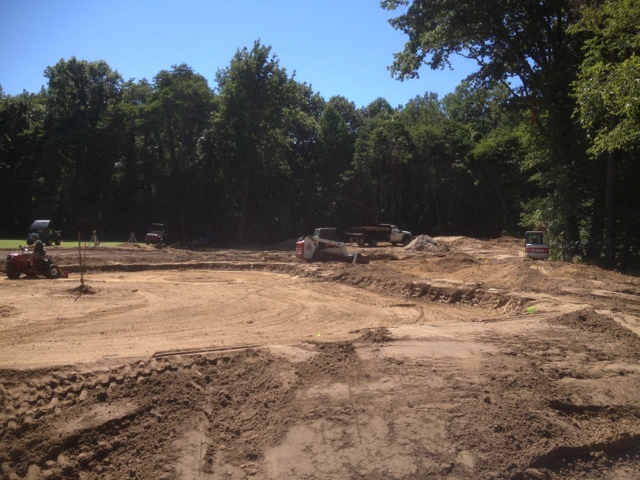
The short game practice area is in full swing. As you may have noticed 2 weeks ago the area was starting to look a little yellow. The cause of this was an application of a product called RoundUp. RoundUp is a non-selective herbicide which kills plants that it comes in contact with. The application is a standard practice in the renovation process, which helps to kill not only the green portion of the grass plant, but also the root. This aspect is important because some grass plants can regenerate new plants from their roots, so during the construction process the soil is moved around the site and if some viable roots remain there is a chance they could regenerate. An undesirable example of this is rough grass (Kentucky Bluegrass/Ryegrass) growing in the short game areas that are intended to be cut down to fairway (creeping bentgrass) height.
Before the construction began we removed all of the sprinklers in the area and capped the irrigation pipe. As you can see from the picture, the grass has been completely killed off at this point.
Here the contractor Vintage Golf is beginning to shape one of the chipping greens.
Here they are shaping the edge of the green and bunker face on the west green complex.
The picture below shows the east green complex being fine tuned. Green surface contours are created during the construction process that will mirror the finished grade after the greens mix is installed. 12" of greens mix will be installed inside the "shell" of the green complex.
Wednesday, August 21, 2013
Thursday, June 13, 2013
The Sand Man Cometh
Tuesday and Wednesday of this week we were playing in the sand. Well, not playing. Applying would be a better description.
Tuesday marked the inaugural day of topdressing tees. Our tees are showing signs of being puffy and in a few small areas scalp marks are occurring after mowing. Topdressing with sand will aid in firming the playing surface, diluting the thatch mat and will also make a smoother tee.
On Wednesday we continued our sand onslaught. #6 fairway has been a focus of our topdressing attention over the past 2 years and the improved conditioning of the fairway is in large part due to this. Our goal is to make an application each month. This is directly dependent on the weather, though.
Friday, May 31, 2013
Rainy Days
Over the past week we have had a number of rainy days. At this point last year we were begging for rain. Remember that?
Today the crew is working on cleaning up leaves and sticks, removing water from the course, cart path weeds, building organization and whatever else we can manage to do without causing damage on the course.
The pic below is of our homemade contraption that we call the "Suck-O-Vac". We started using this machine 6 years ago before our recent drainage improvements. Although the responsibilites of the machine have lessened dramatically over the years, we still have a number of small areas on the course that hold water.
The Suck-O-Vac is an old 200 gallon sprayer tank mounted to a trailer. We then added a wet/dry vacuum to the top. The vacuum sits in the opening for the tank almost perfect and after a little silicone the machine was airtight. The vacuum is plugged into a generator in the back of our cart. After the tank is full a 2" ball valve is opened to drain the tank into an existing drain inlet.
Thursday, May 30, 2013
June Newsletter
Hello
Everyone. I hope you all enjoyed the
spring.
Within
the past month the bunkers were edged and topped off with additional bunker
sand. A detailed map was created of each
bunker diagramming the depth of the sand before the project. Our goal is to have 4-6 inches of sand
throughout the bunker.
#6
fairway was also topdressed during May.
Currently, we have around 2” of sand capping the fairway. We will continue these topdressing
applications throughout the year and the coming years at monthly intervals to
increase the sand cap to our desired 4-6”.
I am sure you will all agree the fairway has improved dramatically over
the last couple of years and the topdressing program has played a big part in
the fairway’s improvement.
The
rough left of 4 fairway is close to being able to play out of. The cold spring has really slowed down the
grow-in process, so thank you for your patience.
Eric
Rank
Director
of Grounds
Tuesday, April 30, 2013
MSU Turf Update
4-25-2013
Spring Flooding of Turf
In the last week heavy rains blanketed most of the state resulting in streams and rivers overflowing their banks and many low lying areas flooding. The water has slowly started to subside and turf that was flooded may be exhibiting damage symptoms. Factors that determine turf survival under water include: turfgrass species, submergence duration, submergence depth, water temperature, and light intensity.
Turfgrass species differ in their ability to survive flooding. Unfortunately there are no hard fast numbers such as Kentucky bluegrass will survive 5 days and creeping bentgrass 15 days under water. Instead species have been assigned relative submersion tolerance ratings: creeping bentgrass – excellent, Kentucky bluegrass – medium, Poa annua and perennial ryegrass – fair. As submergence depthincreases the potential for injury increases. If the leaf tissue is above the water line – even just a little bit – the turf will probably survive. On golf courses many have observed creeping bentgrass floating on the edge and even growing out into a lake. This is a perfect example of turf surviving when partially submerged. The final two factors affecting turf survival are water temperature and light intensity. Both of these factors are working in our favor right now as the air and water temperatures have been cool. Flooding during the summer months when temperatures are higher often result in damage to the turf when it’s submerged for even a short time.
Many golf courses in flood plains have flooded.
As the water recedes, the turf may be yellow or brown. The discoloration is related to the turf losing its ability to take up nutrients. It doesn’t take long once turf is submerged for soil oxygen levels to decline and root hairs to begin to die. As the root system becomes impaired, nutrient extraction and water uptake will be limited. Keep this in mind once the water has receded as the turf may benefit from a light fertilizer application. To assess if submersion has caused injury, extract several plants from the flooded site and cut a horizontal cross section through the crown. If the crown is white and firm – it has survived. If the crown is brown and mushy – it’s dead, so time to develop a reestablishment plan. Finally, for those areas that were flooded due to a stream or river overflowing a bank you are probably dealing with silt or soil deposition. Removal of soil deposition can be difficult and seeding into the deposited soil can be an option. Once successfully reestablished soil cultivation such as core aeration or slicing will benefit the turf by breaking through deposited soil layers to facilitate rooting and water infiltration.
Kevin W. Frank
Associate Professor and Extension Turf Specialist
MSU Turf Team
Saturday, April 20, 2013
Rainy Day Work
At times the grounds crew and I are forced to work inside during or after heavy rainfall events. This was the case on several days over the past two weeks. These particular indoor work days were used to complete a few shop improvements that have been needed for a long time.
Project #1 was to clean. All of the buildings were swept and our breakroom/bathroom area was mopped.
Project #2 was new ceiling lights in our 3rd building. This building was built in 2004 and since then a single light has been lighting the 30' x 60' space. Inadequate to say the least. The building is now brightly lit by 19 energy effficient fluorescent lights.
Project #3 included organization of the 2nd building. This building has been plagued by inadequate floor space for parking equipment, which leads to restricted and/or no areas to walk. The major reason for this safety issue has been the many pallets of fertilizer that come in every spring were stored on the floor.
To remedy this issue we purchased a number of pallet racks and spaced them according along the back wall of the building. Equipment can be parked under the pallet rack shelving, while pallets of fertilizer and divot mix are stored above.
April Showers
Over the past 2 weeks we have received a total of 4 inches of rain. The first rain showers of the previous week were needed as we were actually very dry. That 1 inch of rain was soon soaked up by the ground and we were able to mow greens and fairways this past Sunday.
The remaining 3 inches of rain came this past week between Tuesday and Thursday. Of which, 2.5 inches was over a one day period. Heavy rainfalls such as this result in swollen ponds and additional water hazards on the course.
2 pond from Entrance drive
Path behind 11grn/10T
2 pond looking toward the green from left rough.
2 pond looking toward the Hamlet parking lot.
Subscribe to:
Posts (Atom)